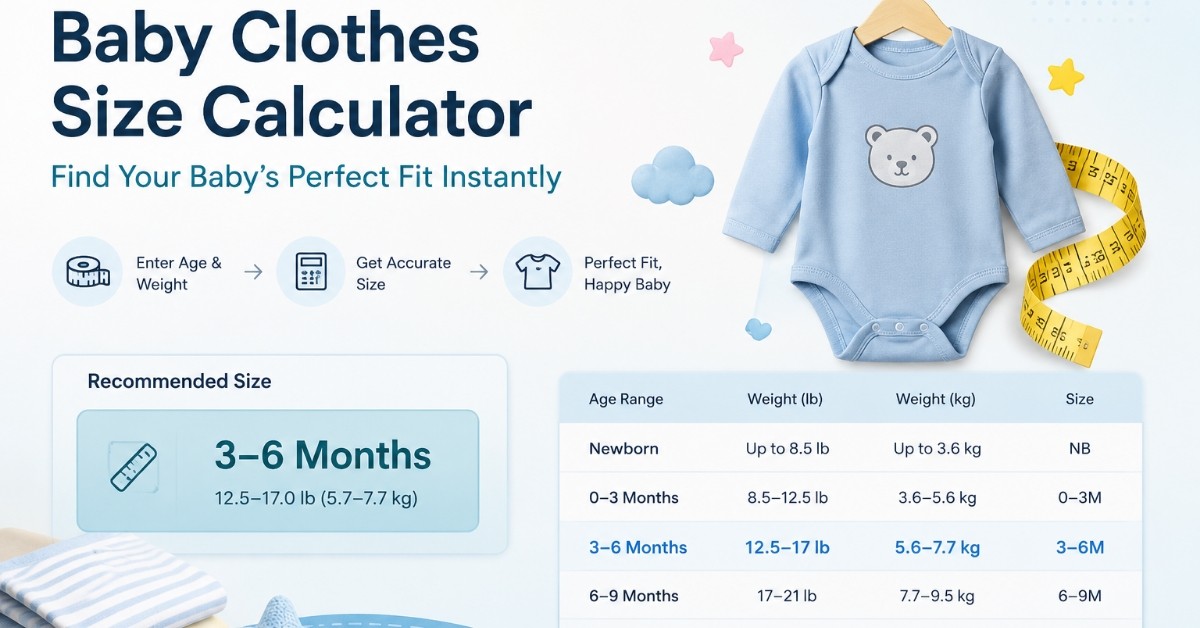
Baby clothes sizes by weight: Newborn (NB) fits up to 8.5 lb (3.6 kg). 0–3 Months fits 8.5–12.5 lb (3.6–6 kg). 3–6 Months fits 12.5–17 lb (6–7.5 kg). 6–9 Months fits 17–21 lb (7.5–9.5 kg). 9–12 Months fits 21–25 lb (9.5–11.3 kg). Weight is more reliable than age — use the calculator below for your baby’s exact size.
Intro
Not sure what size to buy for your growing baby? This free baby clothes size calculator takes the guesswork out of shopping — just enter your baby’s age and weight, and get an instant, accurate size recommendation across the most popular US, UK, and Indian brands. Below the calculator, you’ll also find a full size-by-weight chart, brand comparisons, and tips for buying ahead without wasting money.
Baby Clothes Size Calculator
Tap your baby’s age, enter their weight (or tap a size to jump straight to it), and get an accurate size — plus what to buy next.
Baby clothes size chart by month
Your selected month is highlighted below. Weight is the average for that age — use your baby’s actual weight above for the most accurate size.
| Age | Average weight | Recommended size |
|---|
How to Use the Baby Clothes Size Calculator
What Information You’ll Need
Understanding Your Results
Baby Clothes Size Chart by Weight and Age
Newborn vs 0–3 Months — What’s the Difference?
Size Chart: 0–24 Months (Weight & Height)
| AGE | PROJECTED WEIGHT | RECOMMENDED SIZE |
| 0 months | 6.3 lb (2.9 kg) | Newborn (NB) |
| 1 month | 9.9 lb (4.5 kg) | 0–3 Months |
| 2 month | 12.2 lb (5.5 kg) | 0–3 Months |
| 3 month | 14.0 lb (6.4 kg) | 3–6 Months |
| 4 month | 15.4 lb (7.0 kg) | 3–6 Months |
| 5 month | 16.5 lb (7.5 kg) | 3–6 Months |
| 6 month | 17.5 lb (7.9 kg) | 6–9 Months |
| 7 month | 18.3 lb (8.3 kg) | 6–9 Months |
| 8 month | 19.0 lb (8.6 kg) | 6–9 Months |
| 9 month | 19.6 lb (8.9 kg) | 6–9 Months |
| 10 month | 20.2 lb (9.2 kg) | 6–9 Months |
| 11 month | 20.7 lb (9.4 kg) | 9–12 Months |
| 12 month | 21.2 lb (9.6 kg) | 9–12 Months |
| 15 month | 22.5 lb (10.2 kg) | 9–12 Months |
| 18 month | 23.7 lb (10.8 kg) | 9–12 Months |
| 21 month | 24.8 lb (11.2 kg) | 12–18 Months |
| 24 month | 26.0 lb (11.8 kg) | 12–18 Months |
Baby Clothes Size Guide — Size by Size
Newborn (NB): 0–1 Month
Newborn (NB) size is made for babies weighing up to 8.5 lb (3.6 kg) and measuring up to about 21 inches (53 cm). Most babies born at a typical full-term weight fit this size for just 2–4 weeks before moving into 0–3 Months, and babies born above 8 lb may skip Newborn size almost entirely.
Because this stage passes so quickly, it’s the one size where buying less actually saves money — 4 to 6 bodysuits and one or two going-home outfits is genuinely enough. If you’re shopping for a shower gift and don’t know the baby’s exact birth weight yet, skip Newborn size and go straight to 0–3 Months instead, since there’s a good chance it’ll fit sooner than you’d expect.
0–3 Months
0–3 Months fits babies between roughly 8.5 and 12.5 lb (3.6–6 kg), and it’s the size most newborns actually spend the longest stretch of time in — often 6 to 10 weeks. This makes it the size worth stocking the heaviest: 8 to 10 bodysuits, 3 to 4 outfits, and a few extra sleepers for nighttime changes.
Babies grow fastest in these early weeks, so look for pieces with a bit of extra room in the length and envelope necklines that make dressing (and diaper changes) faster. If a gift-giver asks what size to bring, this is usually the safest answer — it fits longer than Newborn and almost every baby wears it.
3–6 Months
This size covers babies from about 12.5 to 17 lb (6–7.5 kg), typically fitting from around month 3 through the start of month 6. Growth is still fast here, even though the size label spans three calendar months, so it’s common to size up sooner than the label suggests if your baby is tracking on the heavier side.
Six to eight bodysuits plus three or four outfits is a practical amount. This is also a good stage to start buying a few pieces with stretchy waistbands or growth room in the shoulders, since babies begin more active movement — reaching, rolling, and kicking — and snug-fitting clothes can restrict that.
6–9 Months
6–9 Months fits babies weighing roughly 17 to 21 lb (7.7–9.5 kg). This is usually when solid foods start, so expect more spills, stains, and laundry — favor darker colors or busy patterns over all-white outfits for this stage.
Five to six bodysuits and three to four outfits covers most families comfortably. Babies are also becoming more mobile around this age (sitting, starting to crawl), so soft, stretchy fabrics with minimal buttons or snaps at the crotch make dressing quicker and movement easier. If you’re buying ahead, this is a good size to grab a few extra sets of, since it overlaps with messier feeding stages.
9–12 Months
At 9–12 Months, babies typically weigh between 21 and 25 lb (9.5–11.3 kg) and are often crawling, cruising, or taking early steps. Knees and feet of pajamas wear out fastest here, so it’s worth prioritizing a few extra bottoms over tops — four to five bodysuits, three to four outfits, and five to six pairs of bottoms is a reasonable split.
Look for reinforced knees on crawling-stage pants and non-slip soles on any footed sleepers if your baby is starting to pull up and walk. This is also the size where many parents start buying their baby’s first proper shoes, though soft-soled options are still the better choice before walking is fully steady.
12–18 Months
This size fits toddlers roughly 25 to 28 lb (11.3–12.7 kg), spanning a stage where growth slows down compared to the first year — so clothes tend to last a bit longer here than they did in earlier sizes.
Toddlers at this age are usually walking and exploring constantly, so easy on-off pieces (elastic waistbands, minimal snaps) save real time over multiple changes a day. Four to five bodysuits or t-shirts, three to four outfits, and a slightly heavier stock of bottoms works well, since this is peak “sitting on the floor and crawling around” territory even after walking begins.
18–24 Months
18–24 Months covers toddlers from about 28 to 30 lb (12.7–13.6 kg), and by this stage sizing starts shifting toward standard toddler numbering (2T follows directly after this range). Growth has slowed further, so this size often lasts a full two to three months rather than the faster turnover of the newborn stages.
It’s also a good checkpoint to start sizing shoes and outerwear separately from bodysuits, since toddlers this age vary more in height-to-weight proportion than younger babies do. If your toddler runs tall for their weight, sizing up to 2T early is usually the more comfortable call.
Baby Clothes Size Comparison by Brand (Carter’s vs Gerber vs Old Navy)
“If you’re unsure which brand size to buy, our baby clothes size calculator does the conversion for you instead of guessing.”
| Size Band | Carter’s | Gerber | Old Navy |
|---|---|---|---|
| Newborn | NB | Newborn | Newborn |
| 0–3 Months | 3M | 0–3M | 0–3M |
| 3–6 Months | 6M | 3–6M | 3–6M |
| 6–9 Months | 9M | 6–9M | 6–12M |
| 9–12 Months | 12M | 9–12M | 6–12M |
| 12–18 Months | 18M | 12–18M | 12–18M |
| 18–24 Months | 24M | 18–24M | 18–24 M |
US vs UK vs India Size Chart Comparison
“Whichever region you’re shopping in, this baby clothes size calculator automatically adjusts the ranges for you.”
Are US, UK, and India Sizes the Same?
Full Comparison Table
| Size Label | Age | US/UK Weight | India Weight |
|---|---|---|---|
| Newborn (NB) | 0–1 month | Up to 8.5 lb | Up to 3.6 kg |
| 0–3 Months | 1–3 months | 8.5–12.5 lb | 3.6–6 kg |
| 3–6 Months | 3–6 months | 12.5–17 lb | 6–7.5 kg |
| 6–9 Months | 6–9 months | 17–21 lb | 7.5–9 kg |
| 9–12 Months | 9–12 months | 21–25 lb | 9–10.5 kg |
| 12–18 Months | 12–18 months | 25–28 lb | 10.5–12 kg |
| 18–24 Months | 18–24 months | 28–30 lb | 12–14 kg |
Size ranges below are cross-checked against the CDC infant growth charts (US), NHS baby weight guidance (UK), the Indian Academy of Pediatrics growth charts (India), and Carter’s official size chart.
: International Baby Clothes Size Converter (US / UK / EU / India)
Quick Conversion Chart
(EU sizing: 50cm=Newborn, 60cm=3-6M, 70cm=6-12M, 80cm=12-24M)
How Many Clothes to Buy Per Size
“Once the baby clothes size calculator confirms the right size, use this guide to know exactly how much to buy.”
| size | body suit | outfits | bottoms |
| new born | 4-6 | 1=2 | 1-2 |
| 0 to 3 month | 8-10 | 3-4 | 3-4 |
| 3 to 6 month | 6-8 | 3-4 | 3-4 |
| 6 to 9 month | 5-6 | 3-4 | 4-5 |
| 9 to 12 month | 4-5 | 3-4 | 5-6 |
“The growth projection built into this baby clothes size calculator shows you exactly when your baby is likely to size up next.”
Disclosure: This post contains Amazon affiliate links. As an Amazon Associate, we earn from qualifying purchases — at no extra cost to you.
These bodysuits are so cute and comfy for my little ones. Great for everyday wear.
Check Price on Amazon →These onesies are so comfy and cute! Perfect for everyday wear.
Check Price on Amazon →My girls sleep so peacefully in these cozy sleepers. They are a must-have for any new mom!
Check Price on Amazon →How to Buy Ahead Without Wasting Money
The “Buy One Size Up” Rule
What to Skip Buying in Bulk (and Why)
Common Baby Clothes Sizing Mistakes to Avoid
Overbuying Newborn size
Sizing by age instead of weight
Ignoring diaper bulk
Buying a full wardrobe too far ahead
Not checking the brand’s own size chart
“Ready to find the exact size? Scroll back up and try the baby clothes size calculator now.”
Frequently Asked Questions
What size clothes should a 3-month-old baby wear?
Most 3-month-olds wear size 3M or 0–3 Months, but this depends more on weight (typically 11–14 lbs / 5–6.4 kg) than age alone — which is why a weight-based calculator gives a more accurate result than age charts.
What’s the difference between “Newborn” and “0–3 Months” sizing?
“Newborn” is sized for babies up to about 8–10 lbs and is often outgrown within 2–4 weeks, while “0–3 Months” fits babies roughly 8–12.5 lbs and lasts longer — many parents skip Newborn size entirely for larger babies.
Should I buy baby clothes by age or by weight?
Weight is the more reliable indicator since babies grow at very different rates; two 3-month-olds can differ by several pounds and need entirely different sizes.
How many outfits do I need per size?
As a general guide, 5–7 onesies and 3–5 outfits per size is enough for most families doing laundry every 2–3 days, since babies pass through early sizes quickly.
Do Carter’s and Gerber sizes run the same?
No — sizing varies by brand, and the comparison table above shows how a given weight can map to different labeled sizes across brands.
What size should I buy for a baby shower gift if I don’t know the due date size?
6–9 Months or 9–12 Months is usually the safest shower gift size, since newborn and 0–3M sizes are the ones parents already have covered and outgrow fastest.
Are Indian baby clothes sizes the same as US or UK sizes?
The size labels are the same (Newborn, 0–3M, 3–6M, etc.), but Indian size charts run about 5–8% lighter in weight than US/UK charts at the same label — always check your baby’s actual weight against a chart rather than assuming the label alone will translate.
How many baby clothes should I buy in each size?
As a starting point: 4–6 items in Newborn, 8–10 in 0–3 Months, 6–8 in 3–6 Months, and 5–6 in 6–9 Months, assuming laundry every 2–3 days — see the full quantity table above for outfits and bottoms too.
Disclaimer
Last updated: [Month, Year]
The information provided by Ashjyo Creations (“we,” “us,” or “our”) on ashjyocreations.com (the “Site”) is for general informational purposes only. All information on the Site is provided in good faith; however, we make no representation or warranty of any kind, express or implied, regarding the accuracy, adequacy, validity, reliability, availability, or completeness of any information on the Site.
Not Medical Advice
Ashjyo Creations is a parenting and baby care information website. Nothing on this Site — including our articles, size charts, growth calculators, or any other tool — constitutes medical, health, nutritional, or professional advice of any kind. Our calculators (such as clothing size, growth, or feeding-related tools) provide general estimates based on published averages and are not personalized medical assessments.
Every baby is different, and results from our tools may not reflect your child’s individual needs. Always consult your pediatrician, healthcare provider, or a qualified professional before making decisions related to your baby’s health, growth, feeding, sleep, or development. Never disregard professional medical advice or delay seeking it because of something you have read on this Site.
Accuracy of Information
We research and verify the sizing charts, growth data, and product information published on this Site using publicly available sources, including brand size guides and recognized health organizations. However, brands update their sizing, and growth data can vary by population and over time. We update our content periodically but cannot guarantee that every figure is current at every moment. Always cross-check sizing against the specific brand’s own chart before making a purchase decision.
External Links Disclaimer
The Site may contain links to other websites or content belonging to or originating from third parties, including links to Amazon and other retailers, as well as government and health organization resources. Such external links are not investigated, monitored, or checked for accuracy, adequacy, validity, reliability, availability, or completeness by us. We do not warrant, endorse, guarantee, or assume responsibility for the accuracy or reliability of any information offered by third-party websites linked through the Site.
Errors and Omissions
While we do our best to keep the information on this Site accurate and current, the Site may contain typographical errors, inaccuracies, or omissions. We reserve the right to correct any errors, inaccuracies, or omissions, and to change or update information at any time, without prior notice.
Use at Your Own Risk
All information on the Site is provided on an “as is” basis, with no guarantee of completeness, accuracy, timeliness, or of the results obtained from using this information. Your use of the Site and reliance on any information from the Site is solely at your own risk.
About This Site
Ashjyo Creations is a parenting and baby care resource focused on practical tools, guides, and product research for new and expecting parents. You can learn more about our mission and how we research our content on our About Us page.
Contact Us
If you have any questions about this Disclaimer, please visit our Contact Us page or reach out directly — we’re happy to help.